Ghazal music in IRAN and north east of Asia
Ghazal music in IRAN and South east of Asia
There is a kind of vocal music in Iran that called Ghazal khāni. It usually is made based on Ghazal form, a genre of Persian classical poem that generally is sententious, of course sometimes we hear amorous or religious. It has known its origin is in Rey city (olden Tehran) and Kāshān located south of Tehran. In Persian language Ghazal Khāni had composed from Ghazal and Khāni that mean singing. Nowadays this musical form is available in three zone of Iran; Tehran, Khorāsān and Baluchistan provinces.
There is a difference among Tehran style and others. The singers who live in capital city sing without any instruments generally. Morshed Vali Torābi, Iraj, Abbās Qāderi, Reza J’afari, Hasan Shahrestāni and Mortezā Ahmadi are the most popular singers. This style is known as several names such as Kuche Bāqi, Kharābāti, Bābā Shamal, Jāheli, Dāsh Mashti song and Bayāt-e Tehran but in Khorāsān and Baluchistan provinces the singers usually sing with instruments such as Dotār, Sorud, Doholak and Tanburak. Ghazal khāni in Khorāsān usually called Bidel khāni because it is made based on poems of Bidel Dehlavi.

Listen to Ghazal khāni in Tehran style by Morshed Vali Torābi

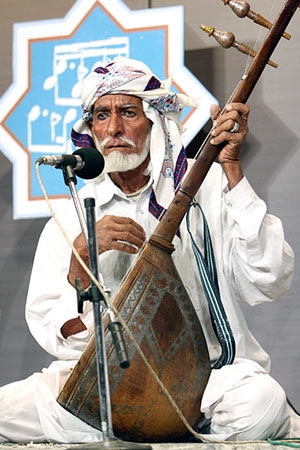
Listen to Ghazal khāni in Baluchistan style that is accompanying by Sorud, Doholak and Tanburak.
Nowadays; we can search Ghazal khāni in other country specially north India and south east of Asia, Indonesia and Malaysia. A different form of this style available in Johor zone in Malaysia that called Ghazal music, it is abbreviated name. Ghazal music came to Johor from Riau-Lingga (Indonesia) before the 1870s. Ghazal is sung in Malay language but its music is very similar to Indian, Arabic and Persian cultures. So we can’t assume that is Ghazal khāni of Iran exactly.
Ghazal music of Johor usually is accompanying by the Sarangi, a traditional chordophone, the Indian sitar, tabla and harmonium, and is still publicly performed in its original form within the Malaysian Indian community. In recent years the violin and the gambus (Malaysian name for Oud) have since replaced the Sarangi and the sitar. Today, modern Ghazal groups also use such instruments as the mandolin, guitar, flute, Japanese drum, accordion, clarinet and ukelele. Ghazal music is non-notational and based on the Indian tal, which basically means that it is built from blocks of rhythmic patterns. (Mohd Ishak 1978).
Listen to Ghazal music in Johor sample 1
Listen to Ghazal music in Johor sample 2
Listen to Ghazal music in Johor sample 3
Listen to Ghazal music in Johor sample 4
Listen to Ghazal music in Johor sample 5
Listen to Ghazal music in Johor sample 6
Previous articles:
The Role of Armenians in Persian Music
The music of Boushehr and the Greek
Nowruz celebration with Persian colorful music
Two instruments which stand for the Persian Gulf
The Especial Instrument for Iranian Ceremonies
The gem of the Persian music ring passed away
Innovative Iranian musical instruments
 Hooshang Samani