Ancient Persian Cymbal
Ancient Persian Cymbal
People who live in the northern littoral regions of Persian Gulf, especially in Boushehr port, have very special, multicolored music. Their music is very unique in Iran. Melodic and Rhythmic wealth of this region’s music is so valuable that it seems people of Boushehr has more music than other Iranians! You can find the reason of this variety exactly in the specifications of portal region of Boushehr. Boushehr was the most important port of Iran during hundreds of years before setting up the railroad of Khorramashar-Torkeman Port. So far, there were many people from different nations and cultures of the world traveling there and naturally they changed the music of Boushehr.
One of the most important aspects of Boushehr music is religious one which is heard as both vocal and instrumental music. In this way, mourning rites of Moharram* month and also rites on the day of Islam Prophet Mohammad’s (PBUH) death are the most important aspects of religious music in Boushehr. This kind of religious music is performed in two forms; in a square-like shape and in indoor spaces like mosques.
Some of the instruments of religious music of Boushehr are Persian cymbal and Damām*. Damām has different types and it is played in other southern cities of Iran. It is not only the musical instrument for mourning rites but Persian cymbal has just ritual-religious use.
According to technical categorization of the world musical instruments, cymbal is one of the self-sound percussions. It means it has no intermediary like skin. Two pieces of metal like two iron plates which are hand palm size are beaten to each other. In far pasts, people made Persian cymbals from brass. A pair of ancient Persian brass was found in ancient region of Ziviyyeh of Kurdistan which belonged to the 1st millennium B.C. this is kept in the Ancient Iran Museum*.
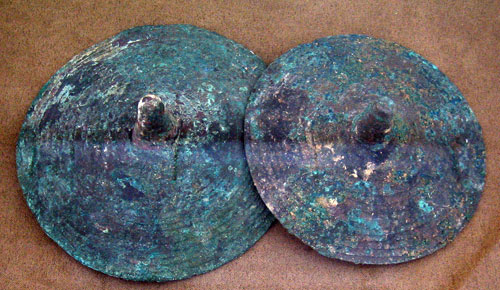
Ancient Persian cymbal, 1st millennium B.C
Persian cymbal is used only in ritual music. It seems that in the ancient age it was also used as the same. Although mourning rites of Boushehr people for Moharram are always in company of Persian cymbal and Damām but nowadays, it is not limited to Boushehr. The oil rich city of Aabādān which has a history near to a century is completely under the influences of Boushehr music, because of neighborhood with Boushehr and also many cultural similarities such as language. Since many years ago, a rite of playing Persian cymbal and Damām is prevalent in Aabādān. Aabādān changed to a war-destroyed city after the Iraq attack to Iran in the last day of summer 1980. Because of war, most of its inhabitants immigrated to other cities. As a result, these rites of Aashoura are held in the provinces which are hosts of war- emigrants who are living there.
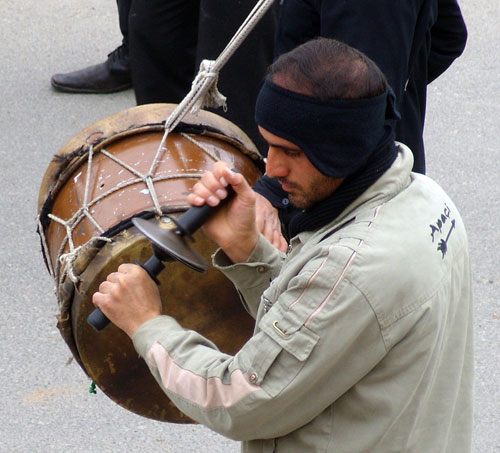
Persian cymbal is always played with Damām
Listen to Persian cymbal accompanied by Damām
Footnotes
Moharram: A name of Arabic month that Imam Hussein (the 3rd Imam of Shiite Muslim) was martyred in it. Annually, Muslims of the world hold mourning rites in Moharram month for the memory of Imam Hussein and his martyr friends and family.
Damām: it is a drum-like instrument which is hang from neck and is played with both hands and also stick.
Ancient Iran Museum: Near Imam Khomayni (Toopkhaneh) square in Tehran.
Translated by Somayeh Ghazizadeh
Previous articles:
Ghazal music in IRAN and north east of Asia
The Role of Armenians in Persian Music
The music of Boushehr and the Greek
Nowruz celebration with Persian colorful music
Two instruments which stand for the Persian Gulf
The Especial Instrument for Iranian Ceremonies
The gem of the Persian music ring passed away
Innovative Iranian musical instruments
Achaemenid Karna sound in Zagros Mountains range
 Hooshang Samani