Rite of Religious Kettledrum Beating in Nayin
Rite of Religious Kettledrum Beating in Nayin
Every region of Iran has many rites which has roots in the centuries of Iranian people’s lives. Some of these rites are similar in different regions but some of them are only specified for a special region. Rite of religious kettledrum beating is one of those rites which are prevalent in nearly half of today Iran although there are some differences in different areas.
Rite of Religious kettledrum beating is held in desert city of Nayin during several important events. It is held in different ways. The first and the most important aspects of the rite are in Moharram days and especially in two important days of Aashura and Tassouaa. It is also performed in the other religious events like the day of Islam’s prophet Hazrat Mohammad‘s (PBUH) death.
Kettledrums are always kept in mosques’ store. Firstly, they put them in front of the sun to eliminate the crumples of kettledrums’ skins whenever they need them. They do this for having the better sound of the instruments. If the weather is cloudy or wet, they do it by the fire heat.

Kettledrums are putting under the sunlight
Kettledrums are beaten with two wooden sticks in Iran’s entire region. One of them is thick and another one is thin. The thick stick has different names in different cultures such as “Asa” (Stick), “Chogan” (Polo stick), “Moshte”, and “Kube” (Percussion), but the thin stick has only one name. It is called “Tarkeh” (Twig).
The main skin of the kettledrum is made from cow’s skin but kettledrum-makers use goat skin for kind of kettledrums which are used for happy ceremonies. Those instruments are thinner than Nayin kettledrums. Nowadays, the body of the instrument is metal but several decades ago it was made of wood. Small kettledrums are still made of wood.
Before the bands of mourners start to move from mosque, kettledrummers stand and beat. This is a kind of informing and calling for mourners to reach to mosques, to participate in the mourning rite, and forming the mourning band for Imam Hussein martyrdom. The rhythm which is used in these rites is 2/2.
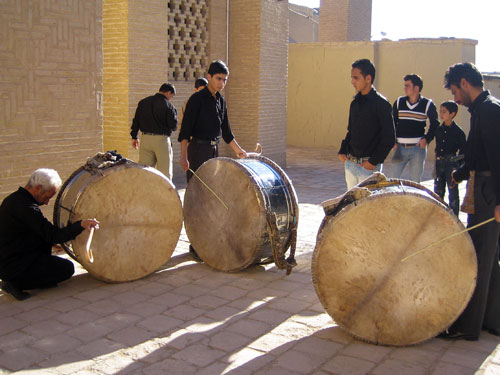
Kettledrummers are beaten informing rhythm for forming the mourning band
When the mourners’ band is ready to move, kettledrums are beaten by their players who are walking in company with the band. Traditionally, they walk in front of the mourning band. Actually they inform the entrance of mourning band to every local.
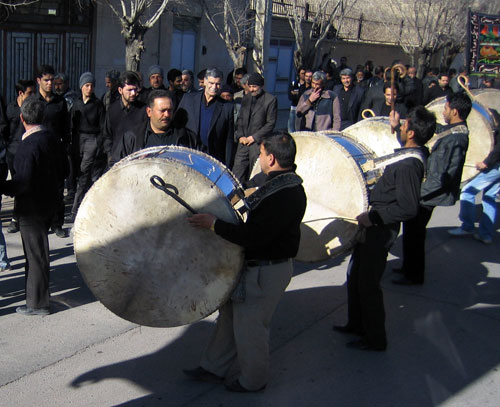
Kettledrummers walk in front of the mourning band
Another form of Nayin religious kettledrum beating is in Ta’ziyeh. Kettledrummers stand besides the Ta’ziyeh square waiting for war and epic scenes. They start to beat on their instruments, when the Moeinolboka(Manager of the T’aziyeh scene) or the main character command them. These rhythms are exciting which are called “Harbi” (war-like).
Sometimes kettledrums are beaten by trumpets and cymbals. Kettledrums are also beaten whenever an important person of a local who has had special social situation is died. With beating kettledrums actually they inform everyone of death of whom. Moreover, they hold dear his memories. This rite is exactly like the Chamari rite of Lorestan or Chapi rite of Bakhtiari which are held for someone’s death.
After finishing the mourning rites, Nayin religious Kettledrummers go to mosques to put their instruments at the store of there. They are not used for any other rite or ceremony. The sound of Nayin religious Kettledrums is the messenger of religious rite or a symbol of assimilated war square of Ta’ziyeh scene.
Special thanks to Ali Afzal Vatan
Translated by Somayeh Ghazizadeh
Previous articles:
Ghazal music in IRAN and north east of Asia
The Role of Armenians in Persian Music
The music of Boushehr and the Greek
Nowruz celebration with Persian colorful music
Two instruments which stand for the Persian Gulf
The Especial Instrument for Iranian Ceremonies
The gem of the Persian music ring passed away
Innovative Iranian musical instruments
 Hooshang Samani