A city full of Color and Music
Rite of A'ashura in Shoushtar, Western-south of Iran
A city full of Color and Music
Every year in Moharram month, Shiite people around the world hold different rites in memory of the martyrdom of their holy Imam Hussein (PBUH) who was martyred on the 10th day of this month 1390 years ago. Holding these rites in Iran is completely different in different provinces, as a tourist can imagine that he/she travels to another country while watching them. Mourning pattern of every region of Iran is actually based on the way of living of its people. For example; in such towns like Abadan which was become famous during recent hundred years because of discovering oil at there, these kinds of rites are simpler. However, in the ancient city of Shuster which is in the 210 KM. of north of Abadan you can find more colorful and more fascinating rites.
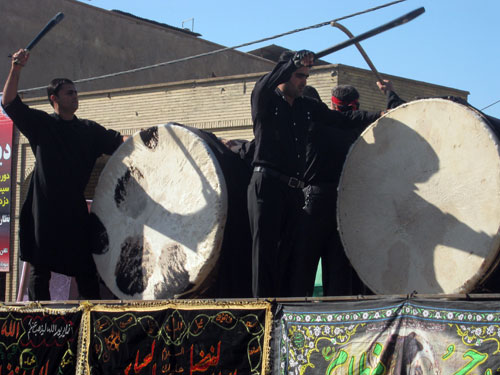
Shuster as a multicultural city helps to the variation; then after you will see thousands of Imam Hussein's mourners which each of them has unique dress and device. Undoubtedly, no part of the A'shura rite is performed in silent and all of them are companied with music. As your eyes could watch the many colors in this kind of rite, your ears also can hear different beautiful kinds of music which are all different from each others.
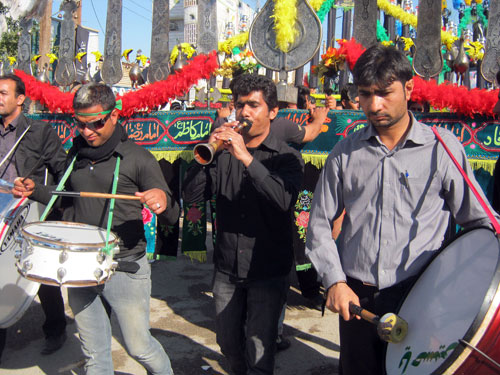
Shuster is a city stayed from ancient eras, when Islam and Christianity did not exist. Today one hundred percent of its habitants are Shiite. They speak not only Persian but also local accents like Lori and Bakhtiari. Also some of them are Arabs who live based on their traditions and their presence in A'ashura rites has their unique smell of Arabian.
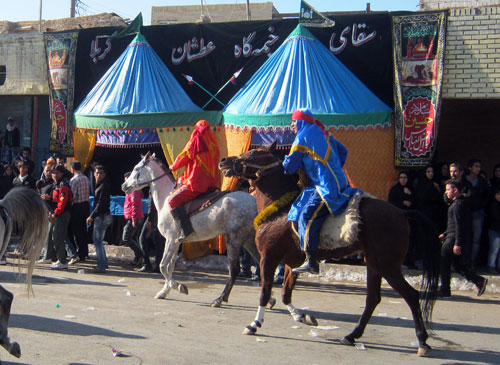
What is demonstrated in the mourning rites of this ancient city is using symbols very much. They almost made a symbol or sign for each part of the rites and they out them on their cars; the symbol of Imam Hussein (PBUH)'s loneliness in at noon of A'ashura when he lost all of his soldiers or the symbol of capturing the children and women after all the men were martyred. Also you can find some legendary signs; like a lion which cries on Imam Hussein (PUBH)'s body. Most of time, one of the mourners plays the act of this artificial lion. Another symbol is referred to fall of angels by the bodies of Karbala's martyrs. Ali Asghar's cradle who was the 6-month baby of Imam Hussein (PBUH) is seen very much too. Shiite people respect much to this symbol because according to the history the 6-month baby was killed by the enemy's arrows in his father's arms.
Translated by Somayyeh Qazizadeh
Previous articles:
The First Flourishing Base of Farsi Language
Rite of Religious Kettledrum Beating in Nayin
Ghazal music in IRAN and north east of Asia
The Role of Armenians in Persian Music
The music of Boushehr and the Greek
Nowruz celebration with Persian colorful music
Two instruments which stand for the Persian Gulf
The Especial Instrument for Iranian Ceremonies
The gem of the Persian music ring passed away
Innovative Iranian musical instruments
 Hooshang Samani