Roudaki; Father of Persian Poetry
Roudaki; Father of Persian Poetry
Around 250 KL of Northern-East of Dushanbe, Capital of Tajikistan Republic, in the arms of huge rocks, a man lies who is famous to every Persian-spoker as the father of poetry. For reaching to his tombthere is no way unless driving with your car to “Panjrud” village which is located in the diverticulum. We have to go there by our own car because there is no public transportation to this village. Gas is very expensive in Tajikistan so travelling is very hard for people; almost they are captivated in their country.
Abu Abdollah Jafar-ebn-e Mohammad Roudaki was born around 865 to 875. His birthday was simultaneously with two famous science features; Mohammad-ebn-e Zakariay-e Raziwjo is one of the most veteran and famous physician and Alpharabius, the famous philosopher called “Second Master”.
Approaching to Panjrud village which is also the homeland and tomb of Roudaki, there is a unique board stealing every Persian-spoker’s attention. Tajik driver cannot read Farsi because it was eliminated during the 70-year reign of Soviet Unions. Then after Tajik people cannot generally read the poetries of their compatriot who composed lyrics thousand years ago.
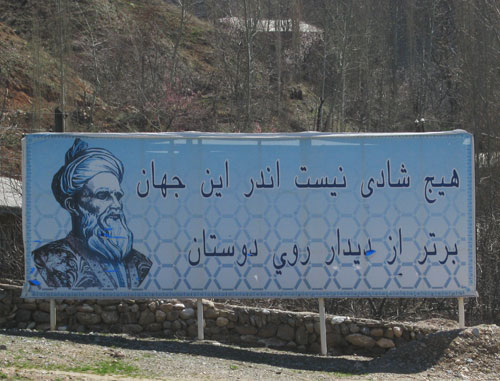
“There is no happiness in this world/ better than visiting friends”
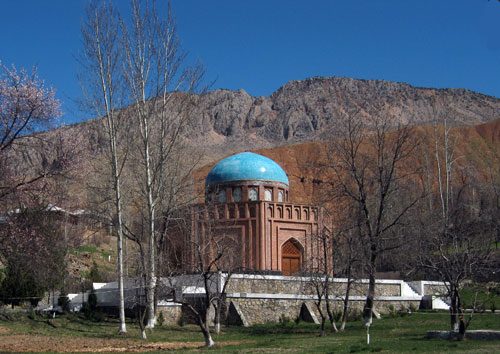
Roudaki’s tomb has no development since thousand years ago until now and it is still small and mint. This small place is very peaceful and strange. A calm angel who has a path to civilized world but a spirit of one of these villagers, called modern people times and times to himself.
Beside the tomb, they’ve built a small building named “Asarkhaneh” (Means house of works). It is obvious that there is a place for seeing the works of some Persian poets and also some ancient pots. On the wall there are Persian and Tajik poetries calligraphies. Because Tajik people cannot read Farsi, there are poetries in Cyrillic calligraphy too.
The very famous lyrics of Roudaki in praising Bokhara- A city in today Uzbekistan- became as proverb for every man of culture. People said that Amir Nasr Samani (Died in 914) was a faithful and wise man who devoted very much. When he went to Herat in Afghanistan, he liked the city a lot. When the local kings saw he didn’t want to return Bokhara, they intermediated Roudaki and he composed some beautiful verses, then he encouraged Amir Nasr Samani to come back to Bokhara.
Translated by Somayyeh Qazizadeh
Previous articles:
Registering Persian Gulf in UNESCO
A city full of Color and Music
The First Flourishing Base of Farsi Language
Rite of Religious Kettledrum Beating in Nayin
Ghazal music in IRAN and north east of Asia
The Role of Armenians in Persian Music
The music of Boushehr and the Greek
Nowruz celebration with Persian colorful music
Two instruments which stand for the Persian Gulf
The Especial Instrument for Iranian Ceremonies
The gem of the Persian music ring passed away
Innovative Iranian musical instruments
 Hooshang Samani